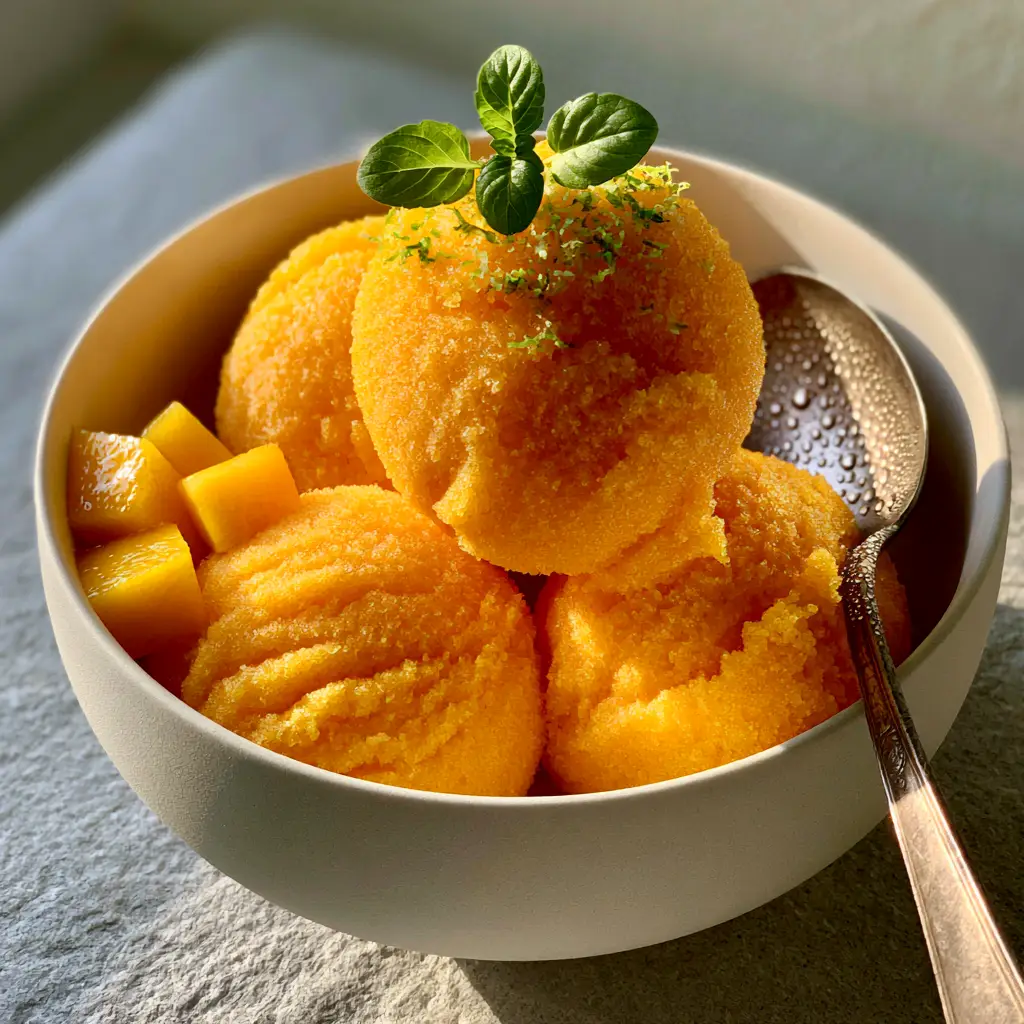
When the sun begins to dip low, casting that unmistakable golden hour glow across your kitchen, nothing satisfies the craving for mango desserts quite like a bowl of handcrafted sorbet. This isn’t just a frozen treat; it is a celebration of tropical intensity and velvety texture.
The beauty of this recipe lies in its forensic precision. We are capturing the essence of ripe, sun-drenched fruit and transforming it into three perfectly round, vibrant orange scoops that look as professional as they taste.
By using high-quality frozen mango and a few strategic botanical accents, you can create a masterpiece that rivals any high-end gelateria. Let’s dive into why this specific preparation stands out in the world of mango desserts.
Why This Is the Gold Standard of Mango Desserts
- The Texture Secret: We achieve a visible velvety, slightly crystalline texture with soft ripples that catch the light, ensuring every spoonful is smooth yet substantial.
- Vibrant Visual Contrast: The deep orange of the mango is brilliantly offset by tiny, bright green baby mint leaves and a fine dusting of lime zest.
- Natural Sweetness: By utilizing organic honey, we create a complex sweetness that enhances the fruit rather than masking it.
- Forensic Freshness: The addition of glistening, precise cubes of fresh mango at the base provides a structural and textural counterpoint to the frozen scoops.
The Anatomy of a Perfect Mango Sorbet: Essential Ingredients
To achieve the result seen in high-end food photography, every ingredient must serve a dual purpose of flavor and structure. When exploring mango desserts, the quality of your base fruit is the single most important factor.
The Base: 1 lb (450g) Frozen Mango Chunks
Using frozen chunks is the secret to achieving that “flash-churned” look. The pre-frozen state allows the fruit fibers to break down into a thick, rippled emulsion without melting into a liquid state during processing.
The Brightness: 2 tbsp (30ml) Fresh Lime Juice
Lime juice provides the necessary acidity to balance the sugar. Beyond flavor, the acid acts as a stabilizer, helping the sorbet maintain its vibrant, deep orange hue and preventing oxidative browning.
The Binder: 3 tbsp (60g) Organic Honey
Honey is an invert sugar, which means it prevents the formation of large ice crystals. This is how we achieve that velvety texture that allows a vintage silver spoon to glide through with ease.
The Garnish: Fresh Mint Leaves and Lime Zest
These are not just for show. The baby mint leaves provide a cool aromatic finish, while the oils in the lime zest offer an immediate citrus hit on the palate.
The Texture Play: 1/2 cup (80g) Chilled Mango Cubes
Adding fresh, glistening cubes at the base of the scoops provides a “real fruit” confirmation. It bridges the gap between the processed sorbet and the raw fruit origin.
Equipment Needed for Professional Results
To master these mango desserts, you need tools that can handle high-density frozen solids. A standard blender often fails here; we need sheer power to create the ripples we desire.
High-Powered Food Processor: This is essential for achieving the visible ripples. The flat blades of a processor incorporate less air than a blender, resulting in a denser, more “scoopable” sorbet.
Heated Ice Cream Scoop: To get those perfectly round, smooth-surfaced scoops, a heavy-duty scoop is required. Dipping it in warm water between scoops creates the slight melting on the outer edge that creates the “glistening” effect.
Chilled Ceramic Bowl: Always use a chilled matte white ceramic bowl. This prevents the base of your sorbet from melting immediately and provides the perfect neutral backdrop for the vibrant orange fruit.
The Forensic Step-by-Step: Mastering the Mango Ripple
Phase 1: The Tempering Process
Remove your 1 lb (450g) of frozen mango chunks from the freezer and let them sit at room temperature for exactly 5-7 minutes. You are looking for a “tempered” state where the outside is slightly soft to the touch, but the core remains rock-hard.
Phase 2: The Emulsion Build
Place the tempered mango, 2 tbsp (30ml) of fresh lime juice, and 3 tbsp (60g) of organic honey into the work bowl of your food processor. Pulse five times to break the large chunks into “mango snow” before running on high for 60 seconds.
Phase 3: Achieving the Velvet Ripple
Stop the processor and scrape down the sides. You will notice the mixture transition from crumbly to a smooth, thick ribbon. Process for another 30 seconds until you see soft ripples forming against the walls of the bowl.
Phase 4: The Hard Chill
For the best “perfectly round” scoops, transfer the mixture to a shallow metal pan and freeze for 2 hours. This firms up the honey-mango matrix just enough to hold the shape of the scoop without becoming an icy block.
Phase 5: The Artisanal Garnish
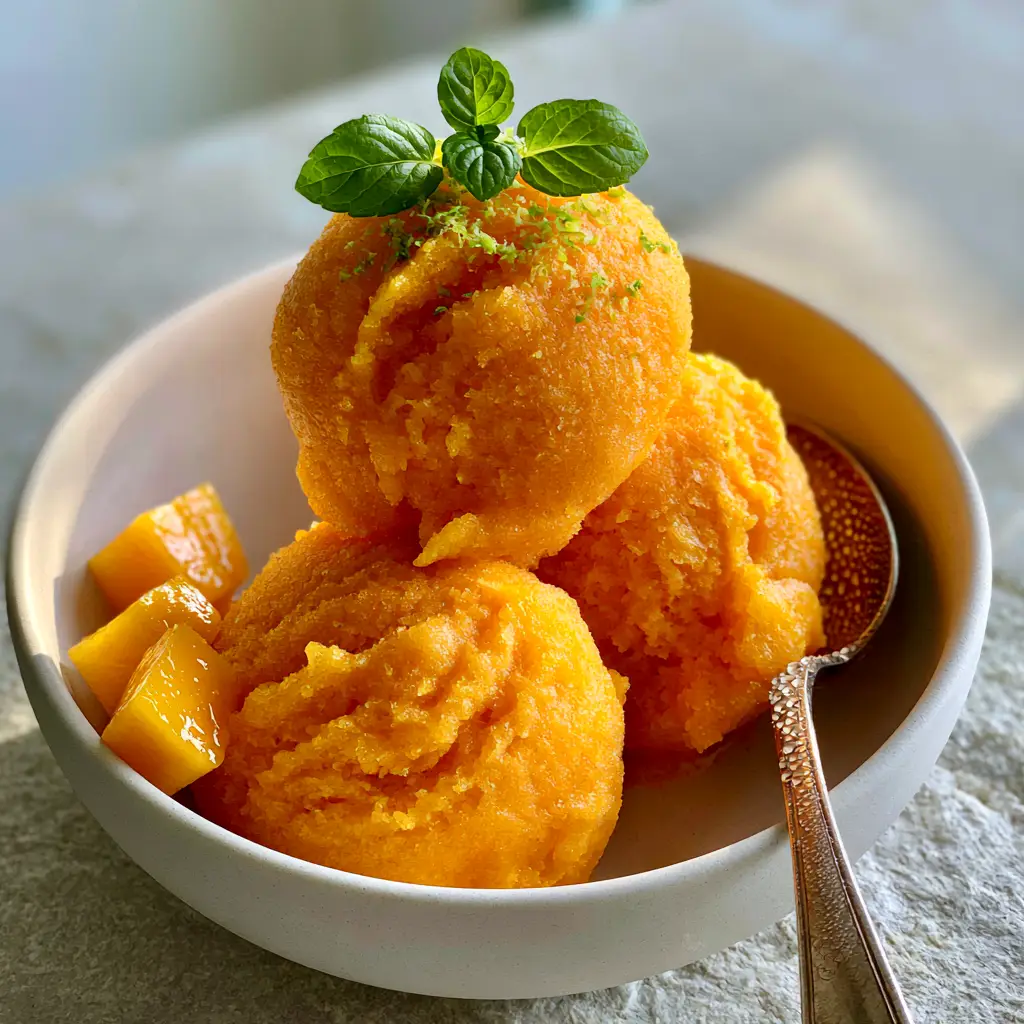
Using a warm scoop, pile three round balls into your chilled bowl. Immediately place three baby mint leaves in a “crown” formation on the top scoop. Microplane fresh lime zest directly over the sorbet, and tuck your glistening mango cubes against the base.
Expert Tips for Perfect Mango Desserts
- Spoon Condensation: For that high-end look, place your vintage silver spoon in the freezer for 10 minutes before serving. When it hits the humid air, it will develop those realistic droplets.
- Honey Substitutions: If you prefer a vegan version, use agave nectar. However, honey provides a thicker viscosity that contributes significantly to the “velvety” visual.
- Mango Variety: If you are dicing fresh mango for the base, look for Alphonso or Kent varieties. They have less fiber and a deeper orange color, which is vital for mango desserts.
- The “Swoosh” Technique: If your sorbet is too firm, let it sit for 2 minutes, then use the back of the spoon to create a small “ripple” on the top of the scoop.
The Science of Preventing Ice Crystals
The biggest enemy of homemade mango desserts is the ice crystal. When fruit juices freeze slowly, they form jagged crystals that feel “crunchy” on the tongue. By using honey and pre-frozen fruit, we bypass the slow-freezing phase.
The honey acts as an anti-freeze agent, lowering the freezing point of the water content in the mango. This ensures that even after a night in the freezer, your sorbet remains “velvety” rather than a solid brick of ice.
Pairing Your Sorbet with Other Tropical Favorites
This mango sorbet is a versatile star. It serves as a refreshing palate cleanser or a decadent finish to a summer meal. If you want to build a full menu of mango desserts, consider these pairings.
For a brunch spread, serve a smaller scoop alongside a bowl of creamy mango chia pudding. The contrast between the icy sorbet and the soft seeds is spectacular.
If you’re hosting a dinner party, this sorbet is the perfect follow-up to a savory dish like Mediterranean stuffed peppers or a hearty chicken cordon bleu. The acidity of the lime and mango cuts through the richness of the main course perfectly.
For a drink pairing, nothing beats a chilled traditional mango lassi. You can even drop a small scoop of the sorbet into the lassi for a “mango float” experience that children and adults alike will love.
Storage and Preservation
While this sorbet is best enjoyed immediately for the “soft ripple” texture, you can store it in an airtight container for up to two weeks. To maintain the mango desserts quality, press a piece of parchment paper directly onto the surface of the sorbet before sealing the lid.
When ready to serve again, let the container sit on the counter for 10 minutes. This allows the honey to soften, returning the sorbet to its original velvety consistency.
Frequently Asked Questions
While a high-powered blender can work, a food processor is superior for creating the ‘rippled’ velvety texture without adding too much air or liquid.
It is best consumed within 2 weeks. For longer storage, press parchment paper onto the surface to prevent ice crystals from forming.
This specific recipe uses honey. To make it vegan, you can substitute the honey with agave nectar or a thick simple syrup, though the texture may vary slightly.
Alphonso or Kent mangoes are ideal for mango desserts because they are fiberless and have a deep orange color that matches the sorbet scoops.
This usually happens if the fruit wasn’t tempered enough or if you omitted the honey. Honey acts as a natural anti-freeze to keep the texture smooth.
The Ultimate Vibrant Mango Sorbet Recipe
Mango Desserts: The Ultimate 3-Ingredient Vibrant Mango Sorbet
Ingredients
Equipment
Method
- Remove frozen mango from the freezer and let sit for 5-7 minutes to slightly soften the exterior.
- Place tempered mango, lime juice, and honey into a food processor. Pulse to break down, then process on high until a velvety, rippled emulsion forms.
- For perfect scoops, transfer to a shallow pan and freeze for 2 hours until firm but scoopable.
- Using a warm scoop, create three round balls. Garnish with mint, lime zest, and fresh mango cubes.
Notes
Vintage silver spoons add a beautiful aesthetic for photography.
Join Our Culinary Community
Creating professional-grade mango desserts at home is a rewarding journey of sensory discovery. We hope this forensic guide helps you capture that perfect golden-hour moment in your own kitchen.
If you enjoyed this recipe, please leave a comment below and share your results! Don’t forget to follow us on Pinterest for more visually stunning recipe inspiration and kitchen secrets. For more inspiration, explore our full collection of easy mango dessert recipes.